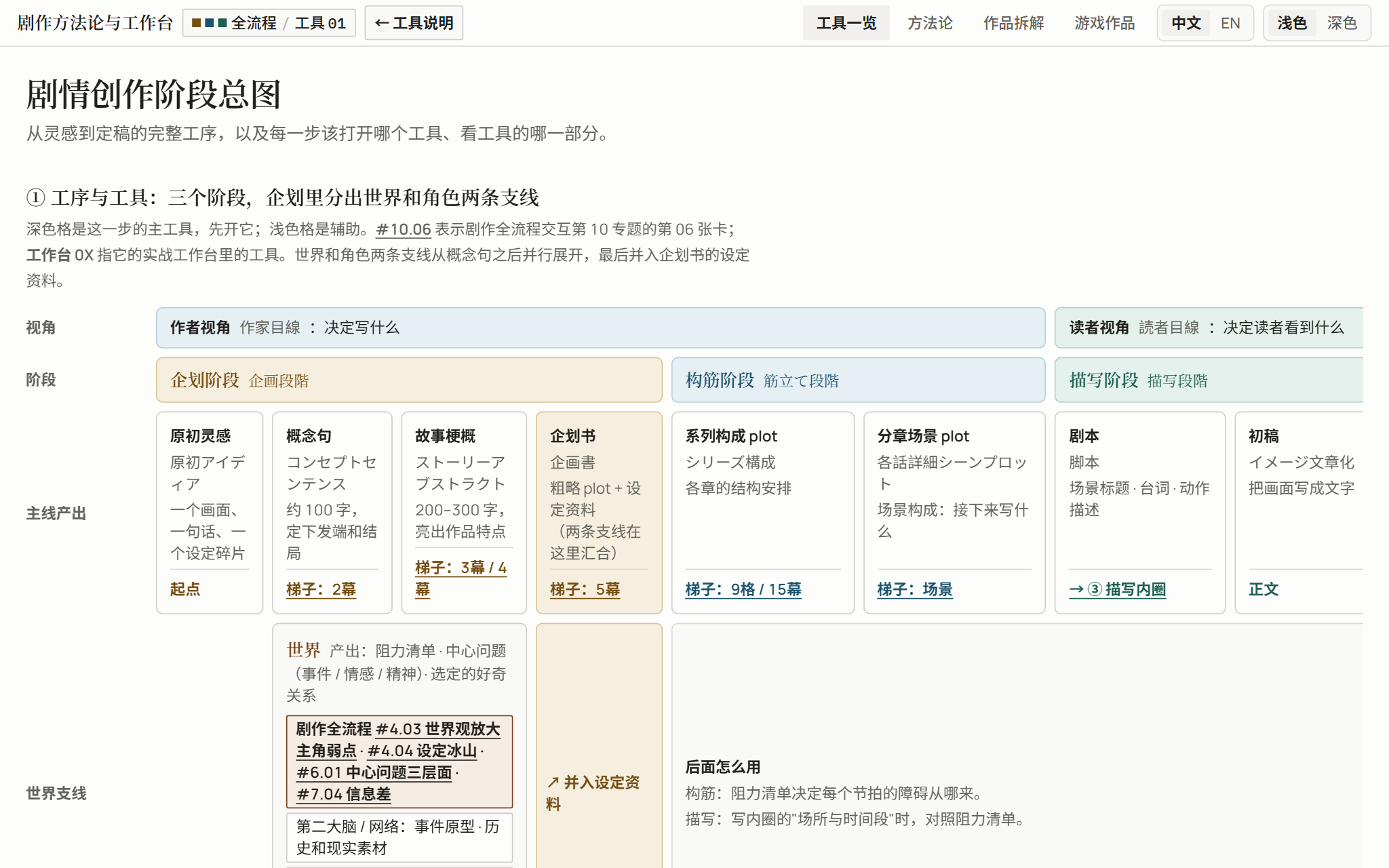
Core Capabilities
- Connects nine main-line deliverables across Planning, Plotting, and Scene Writing with parallel World and Character branches. #pipe
- Steps structurally from 2 acts through 3/4 acts, 5 acts, 9 blocks, and 15 beats down to Eric Edson’s 23 Hero Goal Sequences. #ladder
- Includes chapter allocation tables and word-count conversion formulas for a 120k-character volume. #chtable
- Defines the five-step inner scene loop and transitive action-gerund checks for line-by-line scene execution. #loop
Underlying Methodology
Acts as the routing spine for the three methodology essays: Planning and Plotting calibrate value polarity and sequence shifts, while Scene Writing executes empathy calibration and high-pressure information delivery.
Theoretical References
- East Asian anime & light-novel pipeline (企画 / 筋立て / 描写)
- Kishōtenketsu (起承転結) & Jo-ha-kyū (序破急)
- Eric Edson, The Story Solution (23 Hero Goal Sequences)
- Robert McKee, Story (Gap & Value Change)
- 120,000-character single-volume chapter budget conversion chain
Getting Started in Three Steps
- Open the Story Production Map and locate your current deliverable cell in Section 1.
- Follow the primary link first to complete that deliverable, then consult secondary reference cards as needed.
- Check the structural ladder and five-step scene loop before moving into scene drafting.